

Collect customers from Stripe
Learn how to collect customers from Stripe.
 View as Markdown
Krenalis collects customer data from your Stripe account, maps it to your Customer Model schema, and syncs it with your data warehouse for a unified view of your customers.
How it works
- Select customers. Choose which Stripe customers to import.
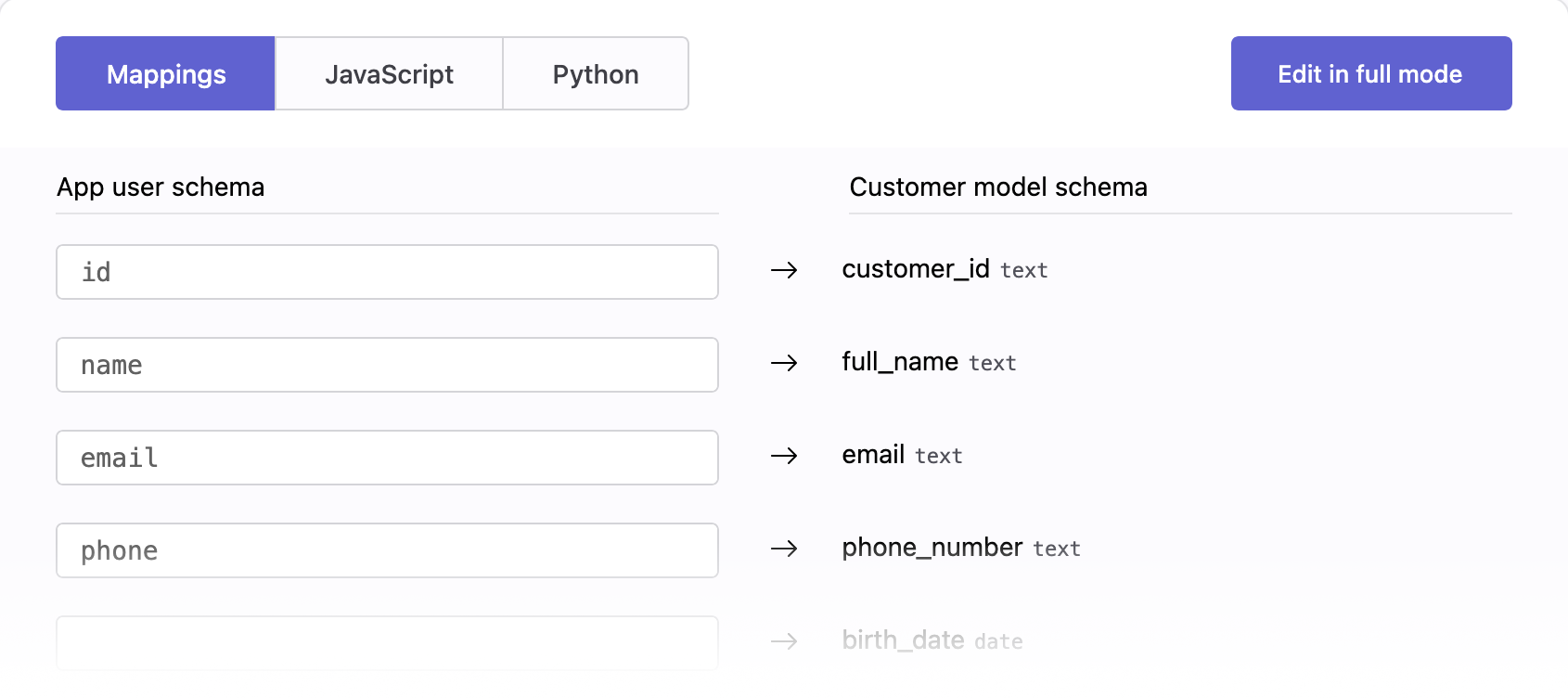
- Map data. Match Stripe fields to your Customer Model using Visual Mapping, JavaScript, or Python.
- Schedule syncs. Define how often Krenalis synchronizes customers.
- Stay updated. Krenalis automatically adds or updates customers as they change in Stripe.
Steps
If you've already added a source connection for the same Stripe account, you can reuse it and start with the Add a pipeline to import customers step.
1. Create a Stripe API key
- Log in to your Stripe account.
- Go to Developers → API keys.
- Click Create restricted key.
- If asked How will you use this API key?, select Building your own integration.
- Enter a name (e.g., Krenalis data destination).
- In the Customers row, enable Read permission.
- Click Create key, then copy the token shown for the new key.
2. Connect Krenalis with Stripe
- In your Krenalis workspace, open the Sources page.
- Click Add a new source ⊕, then select the Stripe card.
- Click Add source....
- Enter the previously copied key.
- Click Add to complete the connection.
3. Add a pipeline to import customers
On the connection page, click on Add pipeline... to define how customers should be imported from Stripe.

Each pipeline defines which data Krenalis reads and how it is structured. You can define multiple pipelines per source to manage different datasets.
4. Filter customers
If you don't want to read all customers from Stripe, use filters to select which customers to sync. Only customers that match the filter conditions will be synced. If no filters are set, all customers will be imported. For more information on how to use filters, see the Filters documentation.

5. Enable incremental import
By default, each import processes all customers in your Stripe account. You can enable Run incremental import to update only customers that have changed since the last sync. This option can help reduce processing time and API usage while keeping your data up to date.

6. Transformation
Use the Transformation section to define how profile data is mapped to Customer Model properties. You can visually map properties from Stripe to the Customer Model, or use JavaScript and Python for more advanced logic (for example, formatting dates or combining multiple properties).
7. Save your changes
When everything looks good, click Add (or Save if you're editing an existing pipeline).
To import another set of customers from the same Stripe account, repeat the process starting from the Add a pipeline to import customers step.
Pipelines
Once saved, the new pipeline appears in the pipelines list for Stripe. From here, you can monitor imports, adjust filters, and manage transformations. Each pipeline defines how and when users flow from Stripe into your warehouse.
With a single Stripe connection, you can create multiple import pipelines to sync different data segments within the same account.

| Column | Description |
|---|---|
| Pipeline | Name and description of the pipeline. |
| Filters | Conditions used to select which customers are imported. If not set, all customers are imported. |
| Enable | Switch to activate or deactivate the pipeline. When disabled, the pipeline will not run, even if a schedule is defined. |
| Run now | Run the import immediately, one time only. Available only when the pipeline is enabled. |
| Schedule | Frequency of automatic imports. You can also run the import manually at any time. |
| Manage | Edit settings such as filter, incremental imports, and transformation |
| ⋮ (More) | Additional options, such as deleting the pipeline. |