

Activate customer profiles on MailerLite
Learn how to synchronize customer profiles with MailerLite for activation.
 View as Markdown
Krenalis makes it easy to sync customer profiles from your data warehouse to MailerLite. By connecting your MailerLite account, you can keep every profile up to date—no manual imports or scripts required. Once connected, Krenalis automatically exports and updates subscribers based on your defined filters and transformations, ensuring your marketing lists always reflect the latest data.
How it works
- Select your profiles. Choose which customer profiles to include.
- Map the data. Match each property from your Customer Model to MailerLite fields using Visual Mapping, JavaScript, or Python.
- Set the schedule. Choose how often Krenalis synchronizes profiles.
- Keep it fresh. Krenalis automatically updates your MailerLite subscribers, adding or updating subscribers when new profiles appear.
The result: your MailerLite subscribers always mirrors your customer data, ready for activation in your marketing campaigns.
Steps
If you've already added a destination connection for the same MailerLite account, you can reuse it and start with the Add a pipeline to export profiles step.
1. Create a MailerLite API key
- Log in to your MailerLite account.
- In the left sidebar, click Integrations → API → Use.
- Click Generate new token.
- Enter a name for the token, such as
Krenalis. - Read and accept the Terms of Use.
- Click Create token.
- Click Download and save the file containing the token in a safe place.
2. Connect Krenalis with MailerLite
- Go to the Destinations page of your Krenalis workspace.
- Click on Add a new destination ⊕ and click on the MailerLite card.
- Click on Add destination....
- Paste the previously copied API key and click Add.
3. Add a pipeline to export profiles
On the connection page, click on Add pipeline... to define how profiles should be exported to MailerLite.

Each pipeline tells Krenalis which data to send and how to structure it in MailerLite. You can define multiple pipelines per destination to manage different datasets.
3. Filter profiles
If you don't want to send all profiles to MailerLite, use filters to select which profiles to sync. Only profiles that match the filter conditions will be synced. If no filters are set, all profiles will be exported. For more information on how to use filters, see the Filters documentation.

4. Set how subscribers sync to MailerLite
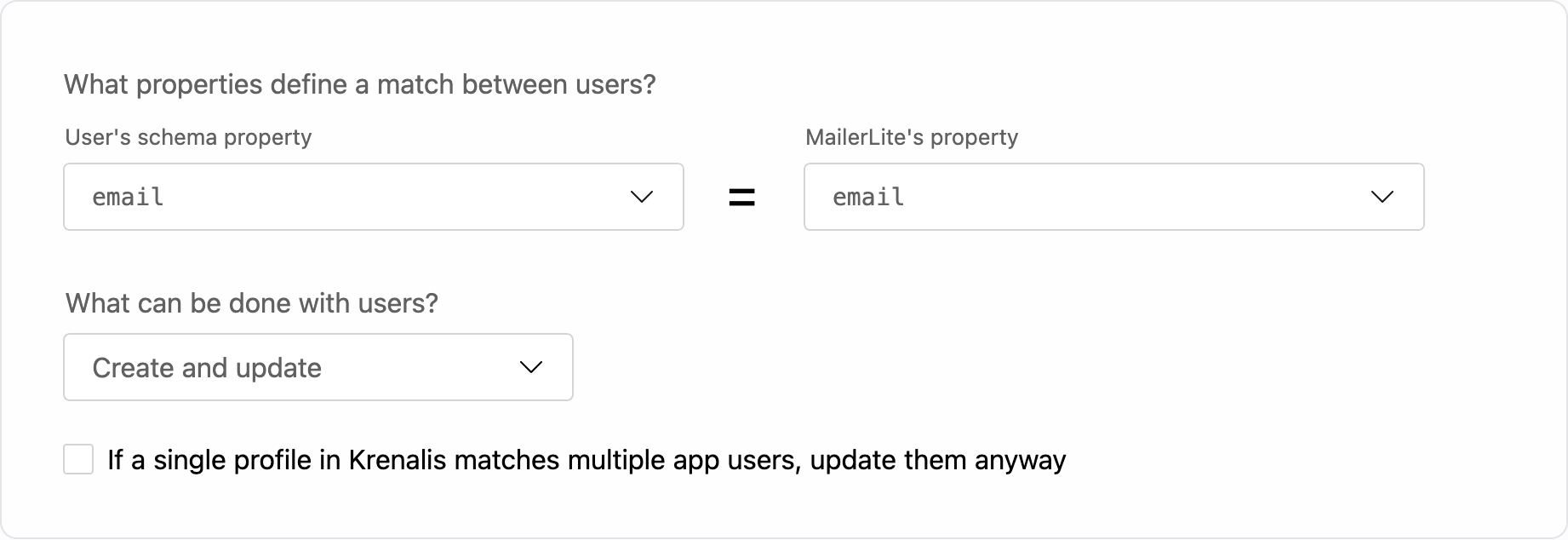
The Export settings section tells Krenalis how to recognize your subscribers and what pipelines to take to keep MailerLite perfectly in sync with your latest customer data — automatically and without manual updates.
-
Choose matching fields
Select one property from your Krenalis data and one from MailerLite to compare — usually something unique like an email address or customer ID. Krenalis uses these fields to check if a subscriber already exists in MailerLite. What happens next depends on the sync rules you choose below. -
Decide how handle each subscriber You can choose to add new subscribers when they don't exist in MailerLite, update existing ones when their information changes, or do both.
-
Manage duplicate subscribers
If more than one Krenalis profile shares the same matching value, you can define how Krenalis should handle them. These settings help keep your data clean and avoid unwanted duplicates in your audience.
5. Transformation
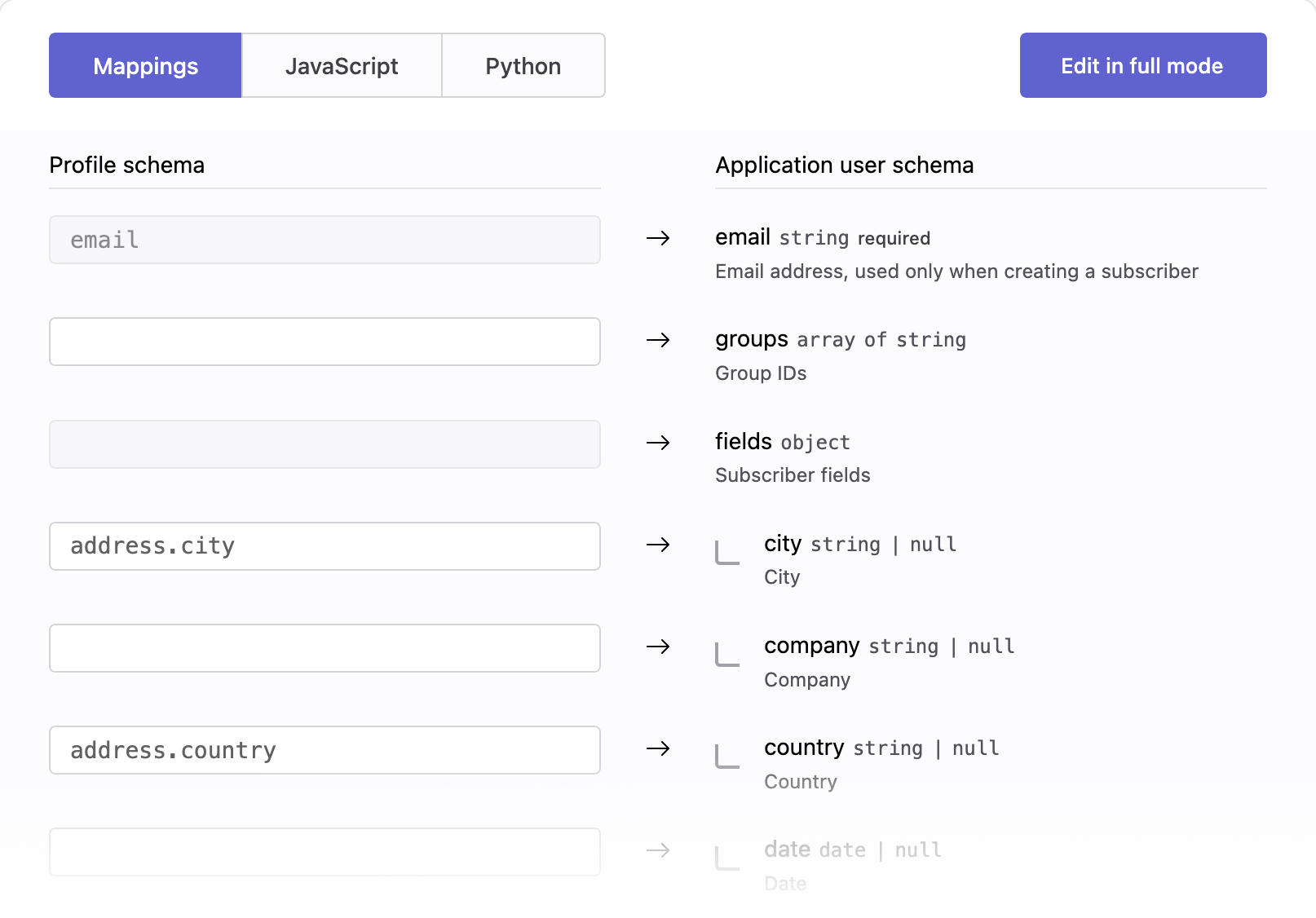
Use the Transformation section to decide how customer data is written to MailerLite subscribers. You can visually map properties from the Customer Model to MailerLite fields, or use JavaScript and Python for more advanced logic (for example, formatting dates or combining multiple properties).
6. Save your changes
When everything looks good, click Add (or Save if you're editing an existing pipeline).
To export another set of profiles, repeat the process starting with the Add a pipeline to export profiles step.
Pipelines
Once saved, the new pipeline appears in the pipelines list for MailerLite. From here, you can monitor imports, adjust filters, and manage transformations. Each pipeline defines how and when profiles flow from your warehouse to MailerLite.
With a single MailerLite connection, you can create multiple export pipelines to sync different data segments within the same account.

| Column | Description |
|---|---|
| Pipeline | Name and description of the pipeline. |
| Filters | Conditions used to select which profiles are exported. If not set, all profiles are included. |
| Enable | Switch to activate or deactivate the pipeline. When disabled, the pipeline will not run, even if a schedule is defined. |
| Run now | Run the export immediately, one time only. Available only when the pipeline is enabled. |
| Schedule | Frequency of automatic exports. You can also run the export manually at any time. |
| Manage | Edit settings such as filter and transformation. |
| ⋮ (More) | Additional options, such as deleting the pipeline. |