
In many AI projects involving customer data, the initial excitement fades quickly.
A company selects a model, builds an assistant, connects it to existing business systems, and expects intelligence to emerge from the combination. The first integrations are usually straightforward: a CRM, a support platform, perhaps a data warehouse or a customer database.
Then a more difficult question appears:
Who exactly is this customer, according to the systems we are asking AI to use?
The answer is rarely as simple as companies expect.
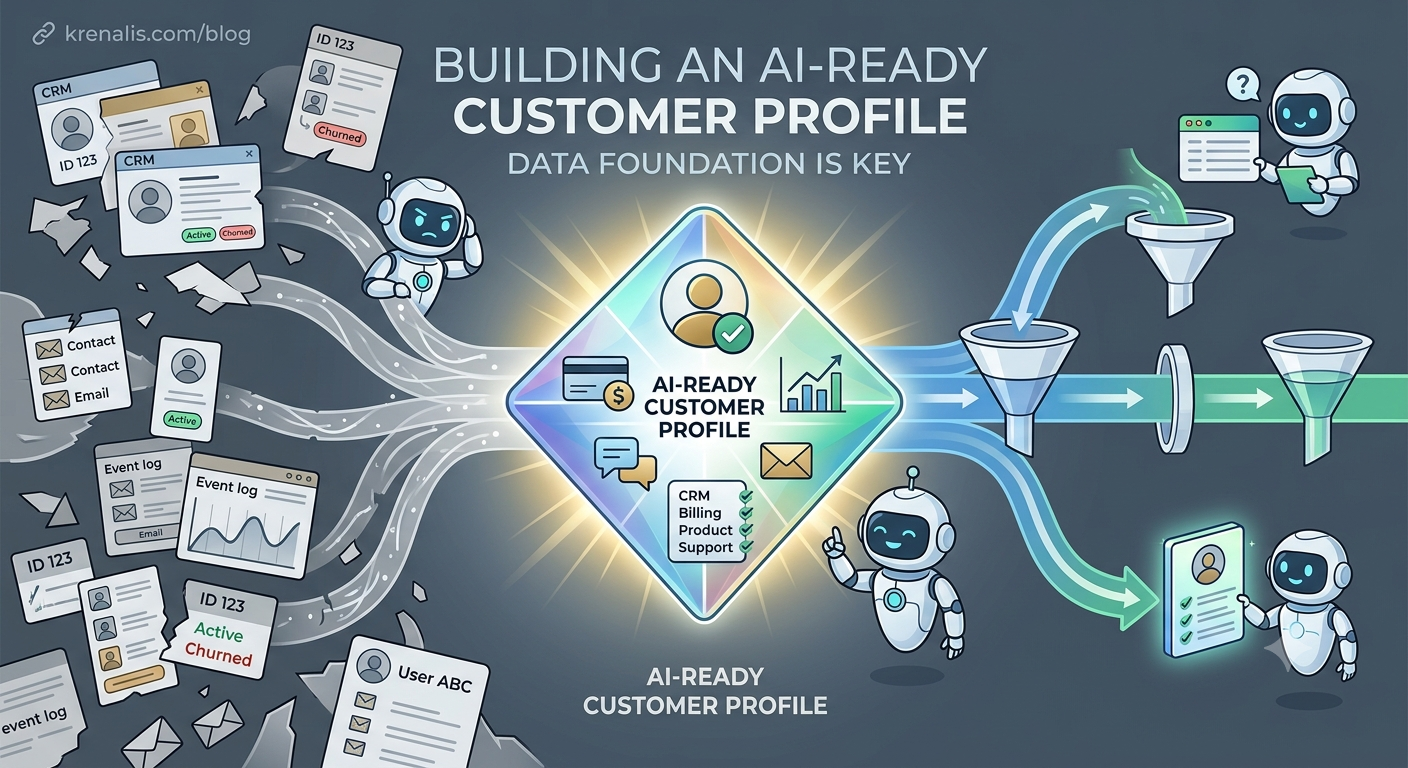
The CRM may recognize a contact. Billing may know a customer ID. The product may track a user account. Support may store conversations under another email address, while marketing automation may contain multiple profiles created at different moments and updated with different levels of accuracy.
Each system contains a piece of the customer story. The problem is that those pieces often do not describe the same person in the same way.
For B2B organizations, the challenge becomes even more complex. A customer is not only an individual. There may be employees, administrators, buyers, operational users, contracts, subsidiaries, locations, domains, and connected accounts. The relationship between a person and a company is rarely represented by a single record.
At that point, it becomes clear that the challenge is not only making AI answer correctly.
The challenge is giving AI a representation of the customer that remains coherent when different systems, identities, and business contexts come together.
Many companies are currently exploring how artificial intelligence can improve customer service, sales assistance, onboarding, retention, and personalization. The conversation often starts with the technology itself: which large language model to choose, which AI platform to integrate, how to design prompts, how to reduce hallucinations.
Those are important decisions. But they come after a more fundamental question:
What customer data are we giving to AI?
Because even the most advanced model becomes unreliable when the information it receives is incomplete, outdated, duplicated, or disconnected from the context in which it should be used.
AI does not create understanding from fragmented data. It amplifies the quality — and the limitations — of the foundation it receives.
Connecting AI to the CRM is not enough
The first instinct in many organizations is simple: connect the AI assistant to the systems that already contain customer information.
The CRM seems like the natural starting point. It contains accounts, contacts, opportunities, and commercial history. A support platform contains conversations and reported issues. Billing systems know subscriptions, payments, and contracts. Product systems capture user behavior and engagement.
All of this information is valuable.
The problem is that value does not automatically become intelligence.
A CRM may describe the commercial relationship without understanding how the customer actually uses a product. A support system may know every conversation but have no visibility into contract value or account status. Billing may confirm that a customer is paying while remaining unaware of growing dissatisfaction expressed through repeated support requests. Product analytics may capture important behavior while failing to connect it to the real customer identity behind those events.
The data exists. What is missing is a consistent interpretation of that data.
Real-world customer identities are messy:
People change email addresses. Employees move between companies. Users register with personal accounts and later connect professional identities. Duplicate contacts appear. Different systems create different identifiers for the same individual. Consent information is collected in one place and not always propagated elsewhere.
These issues are normal consequences of how companies build their technology landscape over time.
But when this fragmented information becomes the foundation for an AI application, the consequences change.
A human operator looking at an incomplete customer record can recognize uncertainty. They can ask another colleague, check another system, or decide not to act until more information is available.
An AI application behaves differently. It takes the information available to it and transforms it into an answer, a recommendation, or an action. The result may sound clear and confident even when the underlying context is incomplete.
That is where the real risk begins.
A customer service assistant may generate a response without knowing that the customer already has an unresolved critical issue. A sales assistant may suggest an upsell opportunity for an account that has recently cancelled. A personalization engine may treat a long-term customer as a new prospect because historical activity was not correctly connected.
In these cases, the problem is not simply that "the model made a mistake."
The problem started before the model was involved.
The Need for an AI-Ready Customer Profile
Traditional customer data models were not created for this new generation of AI applications.
For many years, customer profiles were designed around marketing, sales, and reporting needs. A profile was valuable if it helped companies create segments, launch campaigns, measure performance, or synchronize audiences with external platforms.
Those use cases remain important.
But operational AI requires something different.
An AI application does not only need to know which segment a customer belongs to. It needs to understand whether that information is still accurate, how it was created, and whether it is appropriate for the decision it is being asked to make.
It needs context.
It needs identity.
It needs trust.
This is why organizations need to think about a different type of customer representation: an AI-ready customer profile.
The term itself is less important than the concept behind it. An AI-ready customer profile is not simply a CRM record, a marketing audience, or a collection of every available data point about a person.
It is a governed representation of the customer designed to be understood and used by automated systems without losing control over meaning, origin, and permissions.
Such a profile should make it possible to understand who the customer is, how different identities relate to the same individual or organization, which systems contributed information, how reliable that information is, what happened recently, and which data can or cannot be used for a specific purpose.
This may sound obvious.
In practice, it is one of the most difficult challenges companies face when preparing their customer data for AI.
The Problem with "Almost Right" Data
Companies have always worked with imperfect customer data.
A duplicate contact in the CRM is inconvenient but manageable. A missing event can affect a report, but analysts can usually identify the problem and correct it. An inaccurate marketing segment may reduce campaign effectiveness without immediately creating operational consequences.
With AI, the tolerance for ambiguity becomes much lower.
The reason is not that AI creates new data problems. The reason is that AI changes how quickly and how widely those problems can influence decisions.
An incomplete profile that remains visible to a human operator may trigger a question. The same incomplete profile provided to an AI system may become the basis for an automated recommendation, a customer response, or a business action.
The most dangerous situations are often not caused by obviously wrong data. They come from data that is almost correct.
An “almost right” customer profile creates a false sense of confidence. It looks reliable because individual pieces of information may be accurate, but the overall picture is inconsistent.
Consider a typical scenario:
An AI assistant is connected to the CRM. The integration works. The responses are fluent. The project team sees immediate value.
However, the same customer appears as active in one system, cancelled in another, and still included in a marketing audience created months earlier. Each individual record may be technically correct. The problem is that they describe different moments, different contexts, and sometimes different identities.
From the outside, nothing appears broken.
But the AI application now has to make decisions based on conflicting signals.
It may recommend the wrong next action. It may provide outdated information. It may use customer data in a context where that data should not be used.
This is why AI introduces a new requirement for customer data: not only accuracy, but contextual reliability.
A customer profile must explain not only what is known, but also why it is known, where it came from, and whether it can be trusted for a specific purpose.
A real-world example shows how quickly these issues can become business risks:
In 2024, the British Columbia Civil Resolution Tribunal ruled in Moffatt v. Air Canada that Air Canada was responsible for incorrect information provided by its chatbot regarding bereavement fares. The airline argued that the chatbot had provided inaccurate information, but the tribunal concluded that customers should not bear the consequences of incorrect guidance provided through an official company channel.
The lesson is broader than a single chatbot failure.
Once AI becomes part of the customer experience, the company remains responsible for the information and decisions that flow through it.
The quality of the underlying data is therefore not just a technical concern. It becomes part of customer trust, operational responsibility, and business risk.**
The CDP Question: Is it enough?
Once companies recognize that AI needs a reliable customer profile, the next question naturally emerges:
Can a Customer Data Platform provide this foundation?
The answer is: sometimes.
A CDP was created to solve an important problem. Modern companies collect customer information across many different systems, and they need a way to unify that information, create profiles, build audiences, and activate data across marketing channels.
This capability remains valuable.
However, AI introduces requirements that go beyond traditional audience activation.
Many CDPs were designed primarily around marketing workflows: identifying segments, improving campaigns, personalizing experiences, and synchronizing audiences with advertising or engagement platforms.
An AI application often needs a different level of understanding.
A marketing system may need to know whether a customer belongs to a particular audience.
An AI agent may need to understand whether two identities represent the same person, which information is current, what happened recently, where each piece of data originated, whether consent is valid, and whether that information can be used in the current interaction.
These are different questions.
The distinction is subtle but fundamental.
A CDP used for campaign activation answers questions such as:
“Which customers should receive this message?”
An AI-ready customer data foundation needs to answer questions such as:
“Who is this customer, what do we know about them, why do we believe this information is correct, and what can this AI application safely do with it?”
This is not a criticism of traditional CDPs. They have solved a significant business problem and continue to be valuable technologies.
The point is that organizations should evaluate customer data platforms based on the problems they need to solve today.
A platform designed to create audiences is not automatically the same platform an AI agent needs when it must understand customers, make recommendations, or act on behalf of the business.
AI does not need more Data
A common assumption in AI projects is that better results come from providing more information.
In customer applications, this is often the wrong approach.
The goal is not to give AI access to everything the company has collected over time. The goal is to provide the right information, in the right structure, with the right controls.
More data does not automatically mean more intelligence.
A company may have millions of customer events, thousands of attributes, and years of historical records. But without identity resolution, governance, and context, those additional signals may create more confusion than clarity.
Raw events are valuable because they preserve history. Customer records from CRM, billing, support, and product systems are valuable because they represent operational reality. Internal notes may contain important context.
But these sources should not simply be exposed directly to an AI application.
They need an intermediate layer.
A reliable customer data foundation preserves the original information while creating a controlled, understandable representation of the customer.
Events remain available as history. Source systems remain traceable. Identity relationships can be resolved without losing the underlying records. AI applications receive a profile designed for their specific purpose rather than an uncontrolled collection of raw information.
This separation is essential.
The best AI systems are not those that have access to the most data.
They are those that have access to the most relevant and trustworthy data.
Trust in the Model starts with trust in the Data
Discussions about enterprise AI often focus on models.
Companies evaluate accuracy, hallucinations, security, prompt injection, evaluation frameworks, and governance policies.
All of these areas matter.
But there is an earlier layer that receives less attention: trust in the information AI uses.
Before asking whether AI is producing the right answer, companies should ask whether AI is looking at the right customer.
Where did this information come from?
When was it updated?
Which identities have been connected, and why?
Can this consent still be considered valid?
Is this information appropriate for this specific use case?
If identity resolution rules change tomorrow, can the customer profile be rebuilt without losing history?
These are not only data engineering questions.
They are questions about product quality, compliance, customer experience, and operational responsibility.
Because when AI uses incorrect context, the consequences are visible to customers, employees, and business teams.
The model did not fail because it misunderstood the world.
It acted on the world we presented to it.
Before AI, build the Customer Data Foundation
Many organizations believe they have an AI challenge.
In reality, they often have a customer data challenge that AI has made impossible to ignore.
Artificial intelligence does not eliminate the complexity created by fragmented systems. It exposes that complexity because it consumes customer information more directly and turns it into decisions, conversations, and actions.
Before connecting AI to customer-facing processes, companies need a reliable foundation.
That foundation should be able to collect events and records from different systems, resolve identities, preserve history, respect consent, maintain data lineage, and provide controlled customer views to the applications that need them.
A Customer Data Platform can play a central role in this architecture, but the evaluation criteria need to evolve.
The important question is no longer only how many connectors a platform provides, how many audiences it can create, or how easily it can synchronize segments.
The more important question is whether it can help create a customer representation that AI applications can trust.
Because the first step toward successful customer AI is not choosing a model.
It is understanding whether the organization truly knows its customers.
Not as disconnected records.
Not as outdated profiles.
Not as marketing segments created for a single campaign.
But as a reliable, explainable, and governed identity that reflects who the customer is, what has happened, what information can be used, and where that information comes from.
Without this foundation, AI does not become more intelligent.
It simply becomes faster at spreading the inconsistencies already present in the company's systems.
In the next article, we will explore the practical side of this challenge: what an AI-ready customer profile actually contains, and how it differs from a traditional CRM record or a marketing-focused CDP profile.
Are you planning to integrate AI into your business processes, or do you want to assess whether your customer data infrastructure is truly ready for AI?
Subscribe to our newsletter so you don't miss the second part of this series, or get in touch with the Krenalis team to discuss your data foundation and explore how we can help you build your next AI project.